
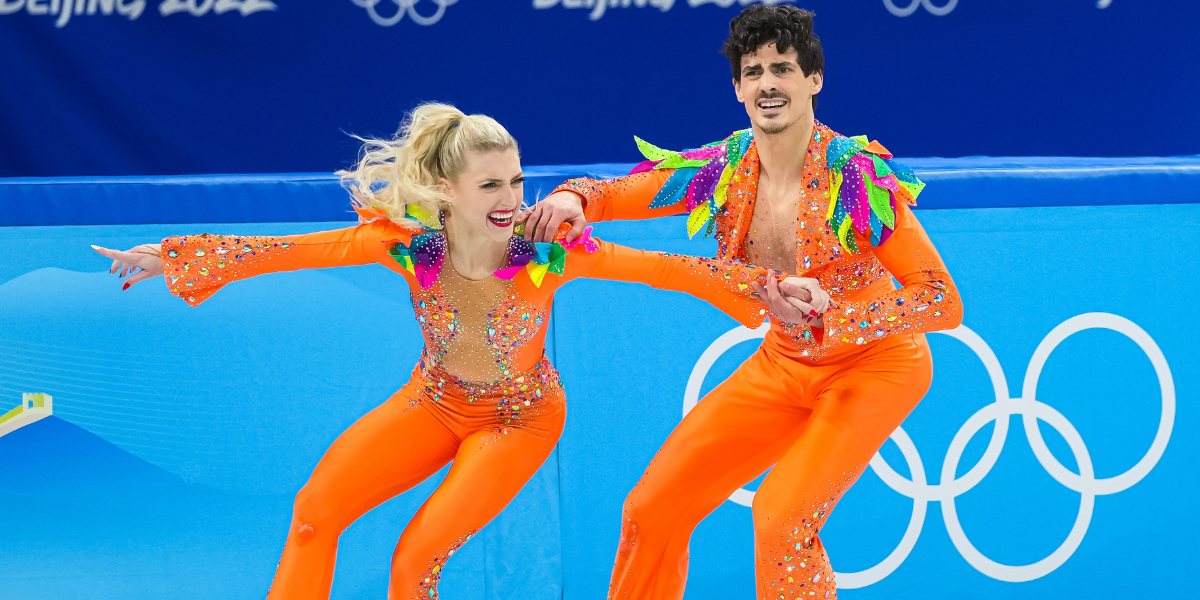
Your Need-To-Know Guide to Olympic Figure Skating
As we count down to the Olympic Winter Games, there’s never been a better time to dive into the world of figure skating. Whether you’re cheering from the stands or tuning in from home, understanding the disciplines will help you enjoy all the action on the ice. Here’s your guide to the essentials of the sport.
Figure Skating Disciplines
In Olympic figure skating, there are four disciplines: men’s singles, women’s singles, pair skating, and ice dance. Men’s, women’s, and pairs debuted at the Olympics in 1908 at the Summer Games and later became staples of the Winter Olympics starting in 1924. Ice dance is a more recent addition, joining the Winter Olympics in 1976.
Synchronized skating, officially recognized as a sport by the ISU in 1994, has its own unique set of rules. While it’s not currently part of the Olympic Winter Games, many fans and athletes hope to see it included one day.
The Short Program vs the Free Program
Single skaters perform two programs: the short program and the free program, each contributing to their overall competition placement.
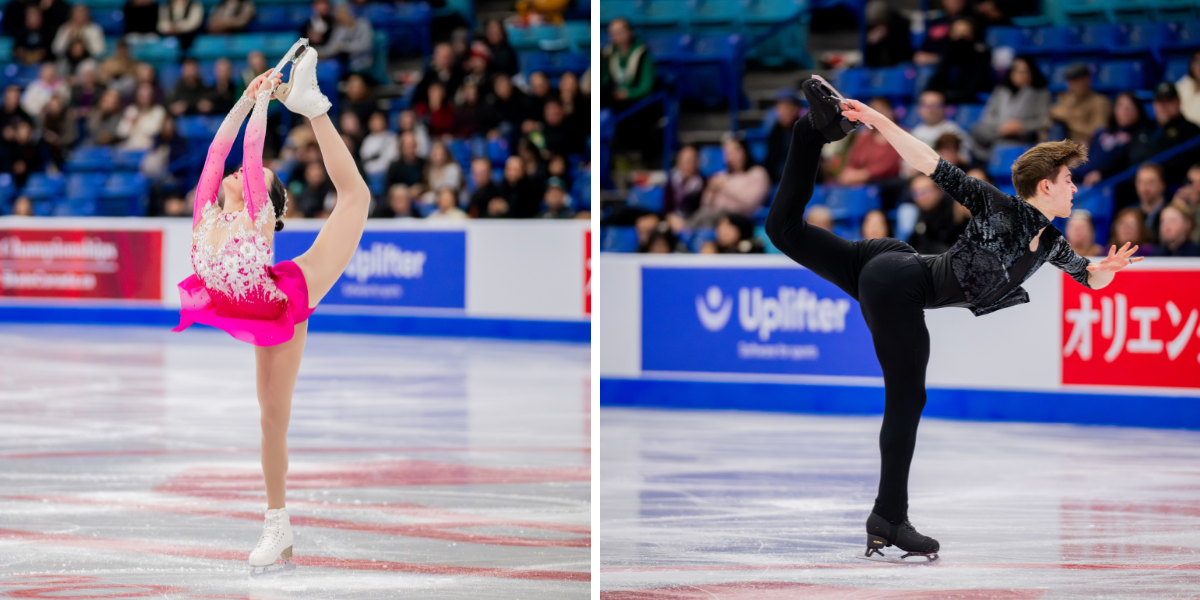
Single’s Spins: Madeline Schizas (left) and Roman Sadovsky (right).
Short Program
- Duration: 2 minutes, 40 seconds (+/- 10 secs)
- Fewer elements mean less room for error.
- Required elements:
- Double or triple Axel
- Triple jump (or quadruple for men)
- Jump combination
- Flying spin
- Spin combination
- Step sequence
Free Program
- Duration: 4 minutes (+/- 10 secs)
- Allows greater creativity and expression.
- Required elements include:
- Up to seven jump elements, including at least one Axel-type jump
- Three spins: spin combination, flying spin (or with flying entrance), one-position spin
- One step sequence
- One choreographic sequence
The combination of both events balances technical skill with artistry, allowing skaters to shine in both precision and performance.
The Difference Between Pairs and Ice Dance
At first glance, pair skating and ice dance may look similar as they both involve two athletes moving together on the ice, but they are distinct disciplines with different rules, styles, and required elements.
Pairs skating emphasizes power, and synchronized athleticism. Two skaters perform side-by-side jumps, spins, and iconic elements like the death spiral.
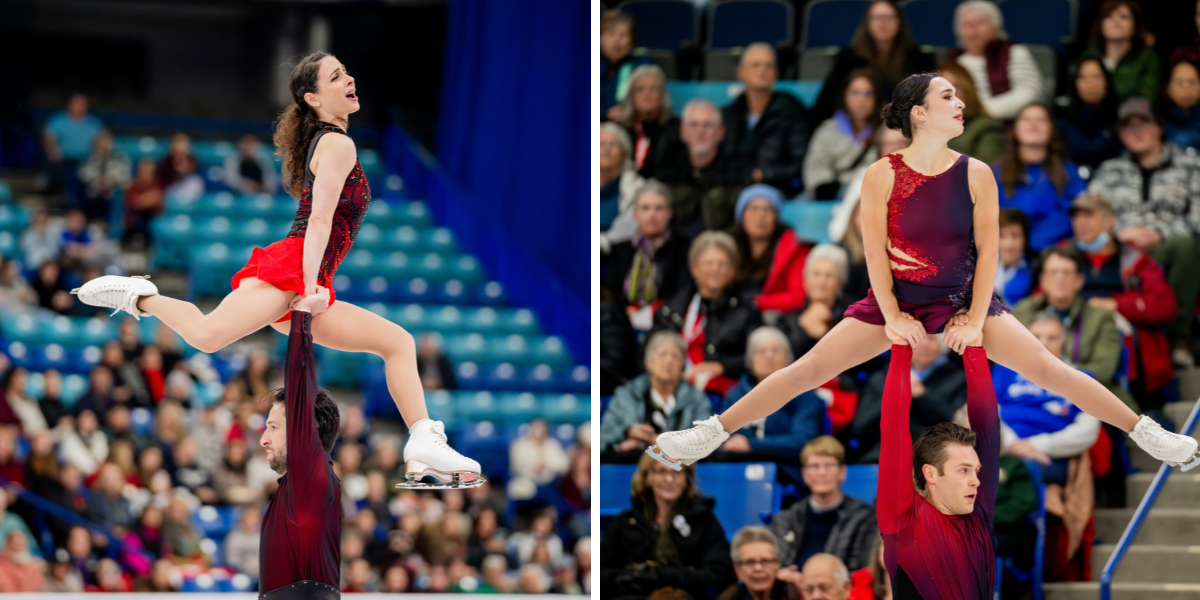
Pair Lifts: Deanna Stellato-Dudek & Maxime Deschamps (left), and Lia Pereira and Trennt Michaud (right).
Pairs also follow the short and free program. The pairs short program includes seven required elements, such as:
- Twist lift
- Throw jump
- Solo jump
- Step sequence
Other elements vary each season. For the 2025–2026 season, these include a lasso lift take-off, a solo spin combination with only one change of foot, and a backward inside death spiral.

Kelly Ann Laurin and Loucas Éthier completing a death spiral.
In the free program, pairs teams have more room to include variety in their program with elements including:
- Up to three lifts from different groups
- Twist lift
- Two different throw jumps
- Solo jump
- Pair spin combination
- A different death spiral than the short program
- Choreographic sequence
Ice dance is rooted in ballroom dancing and focuses on musical expression, rhythm, and precise footwork rather than jumps or throws. This discipline also features two programs, the rhythm dance and the free dance.
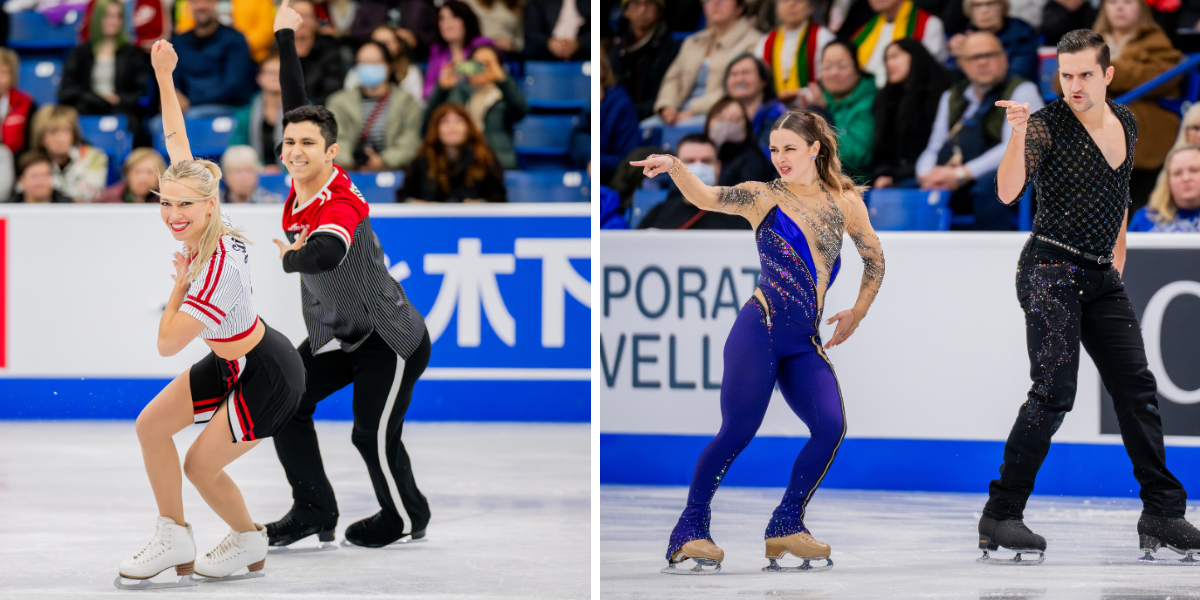
2025-2026 Rhythm Dance: Majorie Lajoie & Zachary Lagha (left) and Marie-Jade Lauriault & Romain Le Gac (right)
The rhythm dance, formerly known as the short dance, must last 2 minutes and 50 seconds (+/- 10 seconds). Each season, it includes a specific pattern dance selected by the ISU and reflects the music and tempo of that season’s theme. For the 2025–2026 season, the theme is The Music, Dance Styles, and Feeling of the 1990s. Key elements of the rhythm dance include:
- Dance lifts
- Dance spins
- Step sequences
- Turn Sequences like twizzles
- Choreographic elements
In the free dance, teams choose their own music, rhythm, and storyline but still have required elements like lifts, step sequences, and choreographic elements. The longer, four-minute, program allows for maximum creativity and emotional expression.
The Olympic Team Event
The team event, introduced at the 2014 Sochi Olympic Winter Games, features countries competing across all four disciplines, with each performance contributing to a combined team score. Only 10 nations qualify based on points earned at ISU events earlier that season.
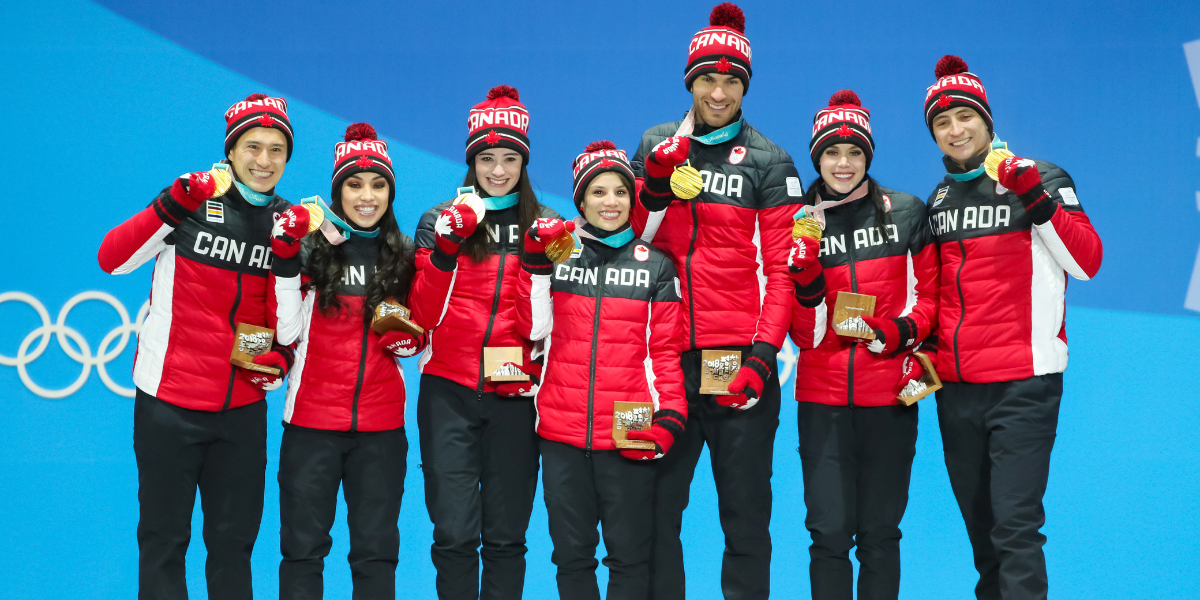
Canada captures gold in the figure skating team event at PyeongChang 2018.
For Milano Cortina 2026, the qualified countries are: USA, Japan, Italy, Canada, Georgia, France, Great Britain, Republic of Korea, China, and Poland.
The competition unfolds in two stages, where teams earn placement points (10 for first, 9 for second, and so on) throughout each discipline segment of the competition. It starts with the Short Program/Rhythm Dance round where each country fields one skater or team per discipline and the top five nations advance. In the Free Skate/Free Dance round, the remaining teams compete in all four disciplines, and the total points determine the final standings.
Now that you’ve brushed up on the essentials, you’re ready to follow every moment of the action when figure skating takes the Olympic stage, February 6-19, 2026. Subscribe to our Olympic Newsletter to stay updated on the latest Olympic Figure Skating news.